TL;DR (4-minute read): Residual value is the estimated worth of your vehicle at the end of your lease term, established at the start of your lease. This value impacts your lease buyout decision, if the residual value is lower than your car’s market value, you could snag a great deal.
And if the residual is higher than market value, a buyout can still be the right call, mileage penalties you'd avoid, and simply wanting to keep the car you know, both count.
And that gap shows up constantly in our own data. Across 19,287 lease buyouts Lease End completed in 2025, all 10 of the most popular buyout vehicles carried positive equity, meaning their market value beat the residual. Drivers captured a combined $73,155,589 in savings, roughly $5,500 in equity per driver on average.
So, you're at the end of your lease. Now what?
You've likely heard terms like "residual value" and "buyout price" thrown around, but what do those terms actually mean?
Residual value is the estimated value of your car at the end of your lease. Your buyout price is the amount it'll cost you to buy out your lease on your leased car. Residual value plays a big role in determining your buyout price, but there are a few other factors calculated into the price as well.
So, let's get into the details. How is your residual value determined? How is your buyout price calculated? And how do you know if a lease buyout is right for you?
(Psst. If you're ready to get going on your lease buyout, call 888-307-5197 for step-by-step help from a buyout advisor, or click the button below.) How is Residual Value Calculated?
Here’s where things get a bit technical (but we’ll make it easy). Lenders estimate how much your car will depreciate over the life of your lease, and that’s what makes up your residual value.
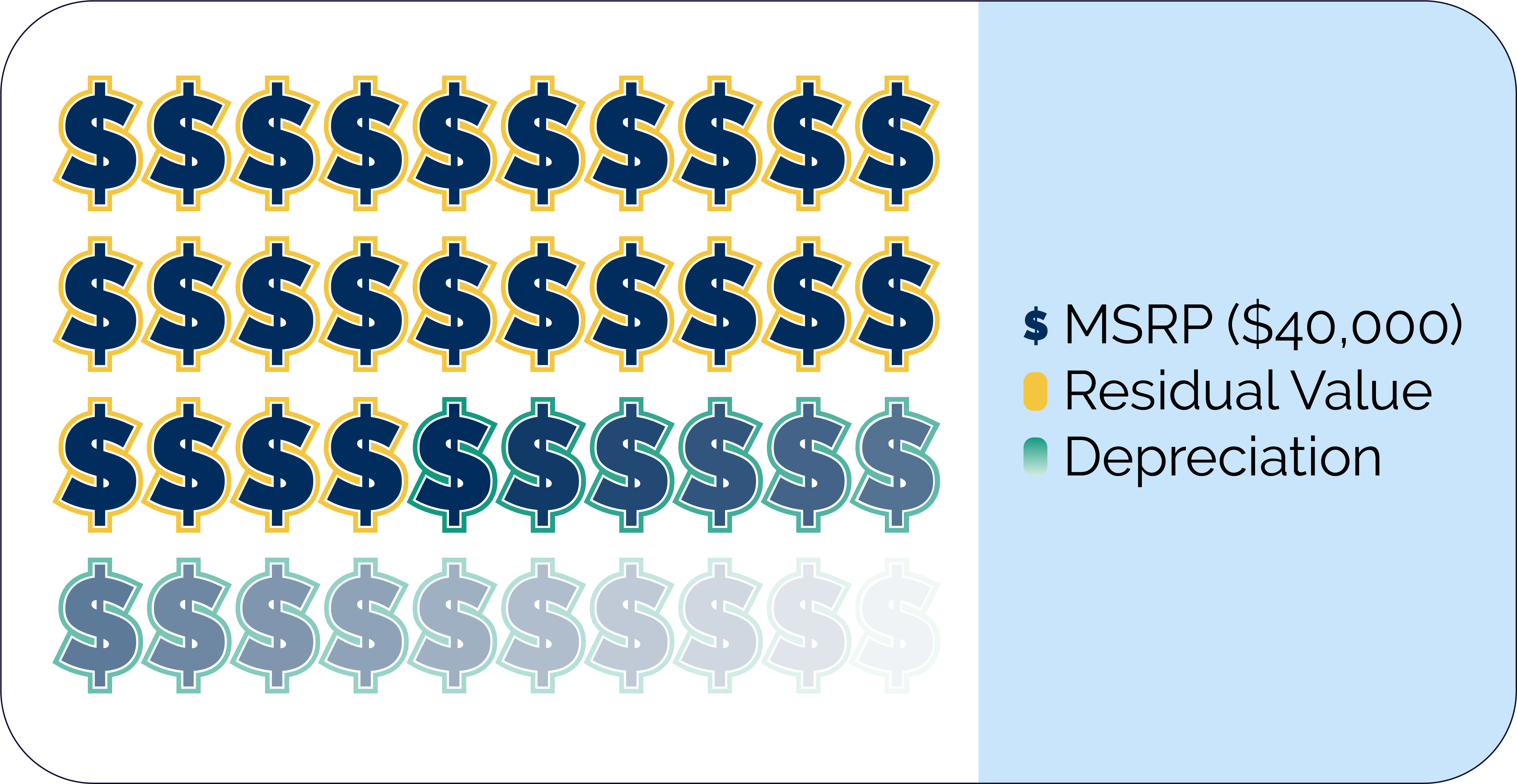
Let’s say your car's
MSRP (Manufacturer’s Suggested Retail Price) is $40,000, and your residual value is $24,000. In this case, the lender predicts your car will lose about 40% of its value over 3 years, which is $16,000.
How do they come up with this?
The calculation factors in things like:
- The car’s make, model, and market trends
- How much the car is likely to depreciate over time
- The lender’s risk
If you're leasing a brand-new car, your monthly payments are covering the depreciation, plus interest, fees, and the lender’s cost of financing the lease.
Why the lender's prediction is often wrong in your favor
Residual values are locked in at signing, but the used-car market keeps moving after that. When values rise faster than the lender expected, the residual ends up set too low, and the difference becomes your equity. We have watched this play out across more than 50,000 buyouts since 2021. One driver of it lately: tariffs on imported vehicles push up the market value of cars already on the road while the residual stays fixed, creating surprise equity for lessees of foreign-built vehicles.
Why Does Residual Value Matter?
If you're considering a lease buyout (i.e., buying your car at the end of the lease), the residual value is key. It's the main factor in determining your buyout cost, and that number helps you decide whether it's a good deal to purchase the car.
For example:
- If the residual value is lower than your car’s current market value, then buying out your lease could be a smart move. You get a car worth more than the buyout price!
How big can the gap actually be? Here are the average-equity figures from Lease End's 2025 buyout data for the models that beat their residual by the most. Every vehicle below averaged more than $5,000 in equity at buyout:
| Vehicle | Average Equity |
| Honda CR-V | $7,950 |
| Honda Accord | $7,378 |
| Honda Civic | $6,850 |
| Toyota Tacoma | $6,598 |
| Mazda CX-5 | $6,242 |
| Subaru Crosstrek | $5,874 |
| Volkswagen Tiguan | $5,739 |
| Honda Pilot | $5,597 |
| Ram 1500 | $5,570 |
- If the residual value is higher than your car's current market value, you are "underwater" on your lease. Worth knowing, but it doesn't take the buyout off the table. Plenty of drivers buy out anyway: because they know this specific car and how it's been treated, because they'd rather not spend a weekend at a dealership starting over in a stranger's car, or because owning it means they can keep it or sell it on their own timeline. Those are the other factors worth weighing here.
Even when you are slightly underwater on equity, the math can still favor a buyout once mileage is in the picture. In 2025 the average Lease End customer turned in at 36,954 miles, about 954 over the standard 36,000-mile cap, and overage fees run 10 to 30 cents a mile. Heavy-mileage vehicles tell the story best: Jeep Wrangler lessees averaged 44,740 miles, roughly 8,740 over the cap, which translates to about $2,622 in overage fees avoided simply by buying the car instead of returning it.
Residual Value in Practice: EVs and Teslas
Residual value can swing hard on electric vehicles, where pricing has been volatile. Our Tesla transaction data (Jan 2025 to May 2026) shows just how different the equity picture is from one model to the next: the Cybertruck averaged $18,098 in equity at buyout, the Model S about $6,267, and the Model Y about $3,695, while the Model X averaged negative equity. The lesson is the same one this article makes: compare your fixed residual against today's real market value before you decide. And if you're the Model X driver reading a negative number, that's one input, not the verdict. The fees you'd avoid at turn-in, and knowing this specific car's charging and service history, sit on the other side of it.
The Bottom Line
We know you’re busy, so we’ll keep it simple. You don’t need to calculate residual value yourself, just factor it in when you’re deciding whether to buy out your leased car.
If the residual value is lower than the car's market value, that's your cue to take advantage of a great deal on a car you already know and love. And if it's higher, the car you already know and love hasn't changed, weigh that gap against what a turn-in would cost you in mileage, wear-and-tear and disposition fees, and against whether you want to go car shopping at all. Returning is a fair option. So is keeping it.
At the end of the day, your next move should feel right for you, and if you need any help, we’ve got a team of lease experts ready to chat. Call us at
888-307-5197, or if you're ready to buy out your lease online, simply enter your license plate number or VIN in the form below.
And you don't have to do the comparison alone. Lease End builds a proprietary 0 to 100 Buyout Score from just your VIN, license plate, and email, weighing popularity, reliability, replacement cost, equity (how your market value compares to the residual), and how you have used the car. It is the fastest way to see whether your residual is working for you or against you before you commit.